

Location, location, location

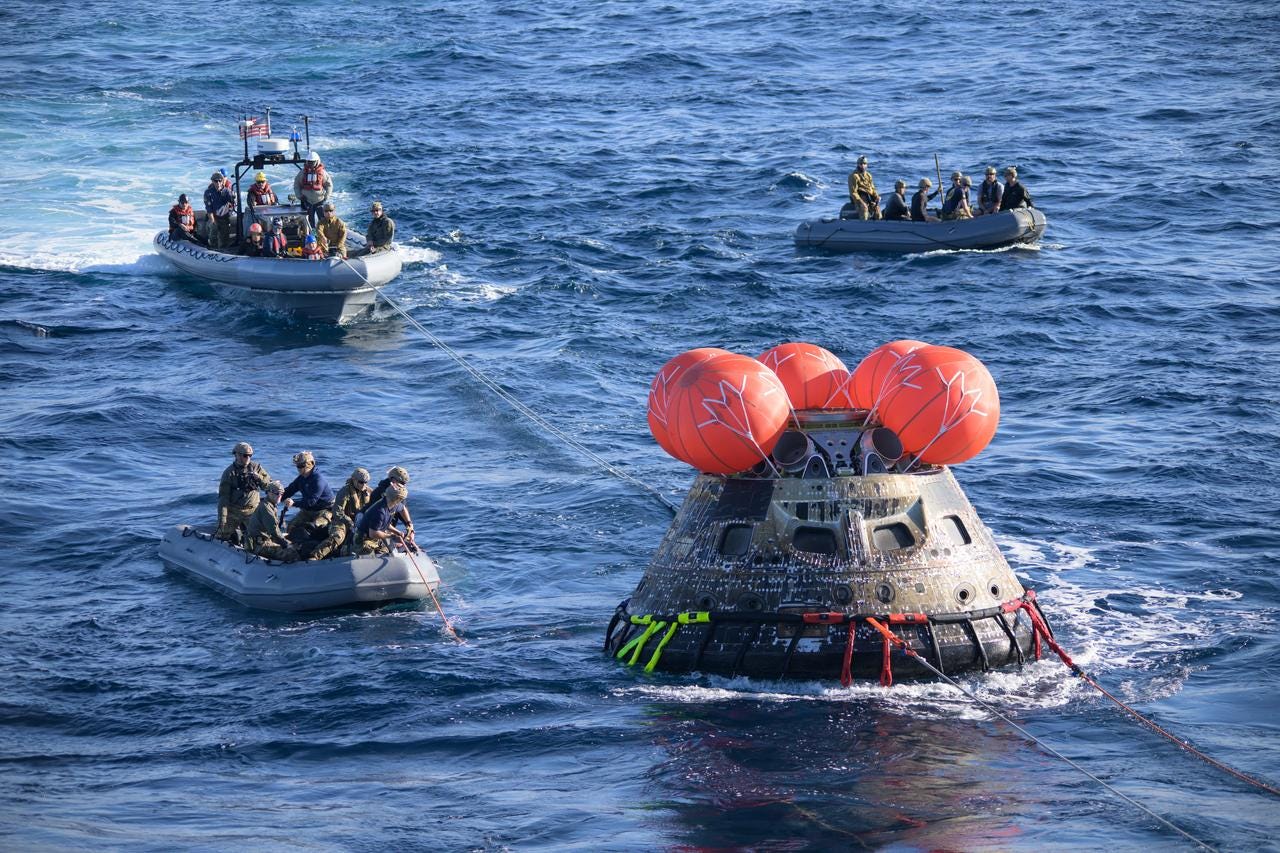
On April 10, the Artemis II crew splashed down in the Pacific off the California coast. They had spent 10 days in space and swung around the far side of the Moon, the first crew to make that trip in over 50 years.
Then NASA put them through an obstacle course. The test was deliberately ordinary: climb a ladder, lift something heavy, walk a straight line, hold your balance with your eyes shut. Simple things a body does without thinking. After 10 days without gravity, the body has to think about them again.
Their inner ears had recalibrated to weightlessness. Fluid had drifted up toward their heads. Blood that normally pools in your legs when you stand had stopped doing that, so the heart quietly cut their blood volume to match.
After a flight this short, none of it does lasting harm. The body still has to undo it, one system at a time.
On the way home, commander Reid Wiseman said Earth was pulling them back, and they were glad for that.
I keep thinking about that obstacle course.
We’ve built our own kind of weightlessness, and you’re probably in it right now. Call it the screen, the feed, the bright rectangle that holds your work, your friends, your news, your arguments, and most of your idle hours.
It’s a real place to do real things. I make a living in there.
You can get real work done in there, even a real laugh with someone 3 time zones away. You just can’t live there. The body won’t sign the lease.
The toll shows up the way it shows up in astronauts, slower and quieter, the same family of symptoms.
Sleep goes first. Astronauts lose theirs to artificial light and a scrambled day-night cycle, and so do we. The glow tells your brain it’s noon at 11 p.m., and the body believes the screen over the sky.
Then attention drifts, and balance in a looser sense gets harder to hold. You look up after an hour in the feed and the room feels faintly unreal, like you’ve stepped off a boat and the floor won’t stay still.
A screen is an environment. It surrounds you and quietly edits what you notice while you’re inside it.
The part most of us skim past is the form itself. What the screen does to you while you stare counts for more than whatever happens to be playing on it.
An environment has a single trick. It goes invisible. The fish is proverbially the last to notice the water, and the screen has gotten about that hard to notice.
Iain McGilchrist, a psychiatrist who’s spent a career on how the brain’s two hemispheres take in the world differently, would say the screen flatters one of them. It’s the half that abstracts and labels things, the half that’s content with a map.
The other half, the one that lives in your body and knows where you are in a room, gets less and less to do. Spend enough hours in the flattened version and the located version starts to feel optional.
That’s what slips away when the body checks out. Place. The plain fact of being somewhere.
Meaning tends to show up local. It happens at a particular table, in a particular kitchen, with the person across from you and the smell of whatever’s on the stove. Presence has an address.
The contemplatives worked this out a long time ago. They keep walking you back to the present moment and the present place: the breath in this body, the light in this room. The holy, whatever that word means to you, seems to prefer an actual body in an actual spot.
So I won’t tell you to delete anything. The astronauts went to space on purpose, and the trip was the whole point.
They had a flight plan, a recovery ship, a medical team on the deck, and an obstacle course to walk them back into their own gravity.
The astronauts planned the way down as carefully as the way up. We climb into the feed for an evening and never set a time to climb out, and the off-balance feeling afterward is the body wondering where it’s been.
Reentry is a practice, and it can be small. Put the phone in another room while you eat. Step outside once a day and let your eyes find something more than 20 feet away, which is a thing the screen never asks them to do.
Watch for the night that has no edge and the scroll with no bottom. That’s the tell. That’s your blood pooling in your legs.
The oldest rule in real estate is the only one anyone remembers. Location, location, location. It turns out to be the oldest rule in being a person, too.
You are somewhere right now, and you have always been somewhere. The body has never once managed to be anywhere but here.
Earth was pulling them back, the commander said, and they were glad of it.
Let it pull you back too. You’ve got gravity here, and a body that knows exactly what to do with it. There’s ground under you with your name on it.
Go visit the other thing. Then come home.