

It Was Never a War
The technology keeps moving. The sides keep shouting. Neither one is winning.

A few weeks ago I watched two people argue about AI at a dinner table.
One of them teaches. She said she refuses to use it, that it cheapens the work, that her students need to struggle with a blank page the way she did. The other works in software. He said she was being “precious”, that she’d get left behind, that the train had already left the station and she could either get on or watch it go.
They both spoke with total certainty. They both thought they were standing on the right side of history.
I didn’t say much. I kept thinking about how sure they each were, and how little their certainty had to do with what was actually happening.
This was never a war. The evolution of technology doesn’t pick teams. It doesn’t read your petition or check whether you posted the manifesto. It keeps moving, indifferent to the people cheering and the people grieving, because it was never paying attention to either one.
The story we inherited
Somewhere along the way, AI got cast as a battle.
Doomers against accelerationists. Artists against engineers. Humanists against technologists. Pick a flag, plant it, defend the ground. Gen Z is often cast as the doomers booing and jeering at commencement speeches of Gen X ‘accelerationists’.
The framing is satisfying. It gives you an identity and an enemy in the same motion. It takes a confusing, formless shift and gives it a shape we all recognize, with a finish line somewhere out ahead where your side wins and the other side admits they were wrong.
I understand the pull. Ambiguity is exhausting. A war, at least, can end.
But the metaphor being used smuggles in a lie. If it’s a war, somebody can win it. And nobody is going to win this, because there’s no one on the other side of the table. The technology isn’t a combatant. It’s the environment we live in. It’s like the weather.
Technique doesn’t take orders
Jacques Ellul saw this coming decades ago, and he wasn’t even writing about computers in 1954.
Ellul was a French sociologist and lay theologian who taught at Bordeaux in France and spent the postwar years dissecting what technology was doing to us. He was also a practicing Christian and a member of the French Resistance, which gave his work an odd double pull. A bleak read on where the machine was taking us, held alongside a stubborn belief that human freedom was still possible if you fought for it.
Ellul wrote about what he called technique, the whole system of methods and tools and efficiencies that, once it gets going, develops according to its own logic. Not human logic. Its own. The system isn’t for you and it isn’t against you. It runs because the conditions that feed it are still in place, and it keeps running whether you approve or not.
This is the part the war framing misses completely. You can hate a thing with your whole being and it will keep developing, because your hatred was never an input. You can love it and evangelize it and it would have arrived on the same schedule with or without you.
You don’t argue with a river about whether it should flow. You learn where it runs deep. You learn where it’s safe to cross. You learn where it’ll carry you off if you stop paying attention. The river doesn’t care about your opinion of it, and that indifference is exactly the thing worth understanding.
We have done this before
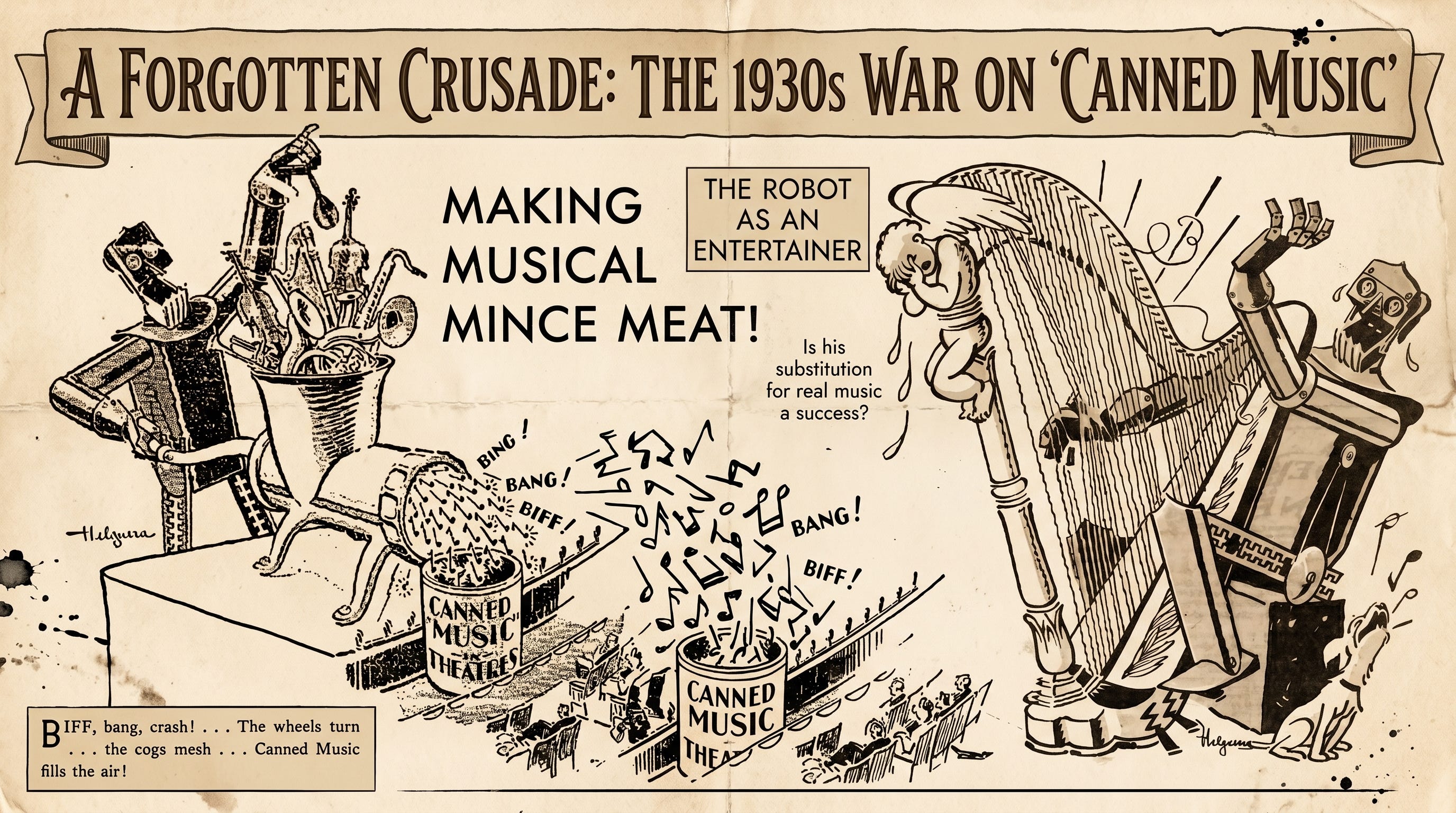
In 1930, the American Federation of Musicians went to war with a robot. (Images above are from this ad campaign)
Not a real one. A cartoon villain they put in newspaper ads across the United States and Canada. Synchronized sound had come to film with The Jazz Singer in 1927, and within a couple of years tens of thousands of theater musicians who’d played live accompaniment to silent movies were out of work. The union formed something called the Music Defense League and spent enormous sums fighting what they called “canned music.”
The ads were not subtle as you can see. One showed a menacing mechanical figure putting real musicians out of work. They even put scare quotes around the word music when they talked about recorded sound, as if a machine couldn’t produce the real thing. The union’s president warned that soon the only living person left in a movie house would be the one selling you a ticket.
You know how it went. The musicians lost. Recorded soundtracks became the default and never gave it back.
And they weren’t wrong, which is the part worth considering. Something real was lost. Thousands of people who made a living with their hands and their training watched that living disappear, and the grief in those ads is genuine. You can feel it a century later.
They were right about the loss and they lost anyway. Both things are true at the same time. The technology didn’t weigh their grief against its momentum, because grief was never on the scale or what was being measured.
I think about the calculator fights too, the ones that ran through classrooms in the 1970s and 80s. Teachers and parents were certain that letting kids use the machine would rot their ability to do arithmetic in their heads. A lot of us did lose that ability. The critics were partly right. They lost that fight anyway, for the same reason the musicians did.
Same shape every time. Champions on one side, critics on the other, both performing certainty. The technology does what it does. And the people who actually got somewhere were the ones who skipped the war and asked sharper questions about what to keep and what to let go.
The grief is real
I want to be careful here, because the resistance to AI is easy to caricature and I don’t want to do that.
People are right to grieve. Artists are losing work right now, today, to systems trained on the very work they’re losing. Students are losing the productive friction that builds a thinking mind. Real relationships are getting routed through something that doesn’t breathe.
None of that is hysteria. The grief is legitimate and the losses are concrete.
The framing is where it goes sideways. Calling it a war tells you there’s something to defeat, and so you pour your energy into defeating it. You write the manifesto. You sign the petition. You declare the thing illegitimate, not real creativity, soulless, canned.
And the river keeps flowing, the way it was always going to, while your real grief gets spent on a battle with no opponent.
The cheering is also a performance
The boosters are doing their own version of the same thing.
The people who treat every model release like a moon landing are performing too. They want to be on the winning team so badly they’ve confused adoption with wisdom. Using the tool early becomes a personality. Skepticism becomes a character flaw.
Enthusiasm without discernment is just avoidance. The cheerleader and the doomer are closer than either would like to admit. Both of them have decided the question is which side to join, when that was never the question.
What indifference actually means
That word, indifferent, needs some precision.
The technology being indifferent doesn’t mean it’s neutral, and it doesn’t mean it’s malicious. It means there’s no moral position inside the tool itself. The values don’t live in the machine. They live in us, in how we use it, in what we permit, in what we refuse.
A recorded soundtrack didn’t believe in anything. The calculator had no opinion about your mental math. The model generating text right now doesn’t want to replace the writer, and it doesn’t want to free her either. It’s running a process.
Mistaking that running for intention, good or evil, is how we keep losing the actual argument. We aim our outrage at the tool and the tool absorbs exactly none of it, while the people making real decisions about ownership and profit and labor get to keep making them off to the side.
Your opinion matters enormously for how you live with this. It matters for what you teach your kids and what you protect in your own work. It matters for nothing at all when it comes to whether the thing arrives.
A different way to stand
What’s left, if not the war?
Not neutrality. Not surrender. There’s an older idea about third-way thinking, the refusal of the binary that gets handed to you, and that’s close to what this moment asks for.
You hold the grief and the curiosity in the same hand. You stay close to what’s human in the work, the part no system can run for you. You pay attention to formation, what these tools are making of you, and not only to function, what they can do for you.
A few things I try to actually practice:
Ask what the tool reveals about us, not only what it does for us. The fights we pick say more about our fears than about the technology.
Build literacy in the people around you, especially the young ones, who are going to live inside this whether or not anyone declared a winner.
Refuse the binary every single time someone hands it to you. The dinner table is full of people who want you to pick a side. Decline.
And notice when you’re performing a side instead of thinking. It feels almost identical from the inside. The tell is certainty.
Back at the table
I keep imagining a third person at that dinner.
Someone who lets the teacher and the software guy go a few rounds, who doesn’t take the bait, and who eventually asks a question that makes them both stop. Not whose side are you on. Something more like, what are you afraid of losing, and is this fight the way to keep it?
It’s quieter than a war and it doesn’t come with a flag.
The musicians lost their fight and recorded sound stayed. What they couldn’t see from inside the ‘war’ was that the question was never whether the machine would win and intentionally take their jobs. It was what they wanted to keep playing once it had. Some of them figured that out and kept making music that was recorded. The rest spent their grief on a robot in a newspaper ad.
We get the same choice. The technology already decided it isn’t on anyone’s side. Deciding what we do with our hands, and our students, and our attention, is the only part that was ever ours to settle, and it will continue to be. I say, let’s refocus our attention on that.